Are you an Aristocrat or a Peasant?
It isn’t a matter of rank or seniority, though it is connected, it is whether you are in the circle, the gang, one of the guys, ‘U’ rather than ‘non-U’. It is a social group as well as authoritative.

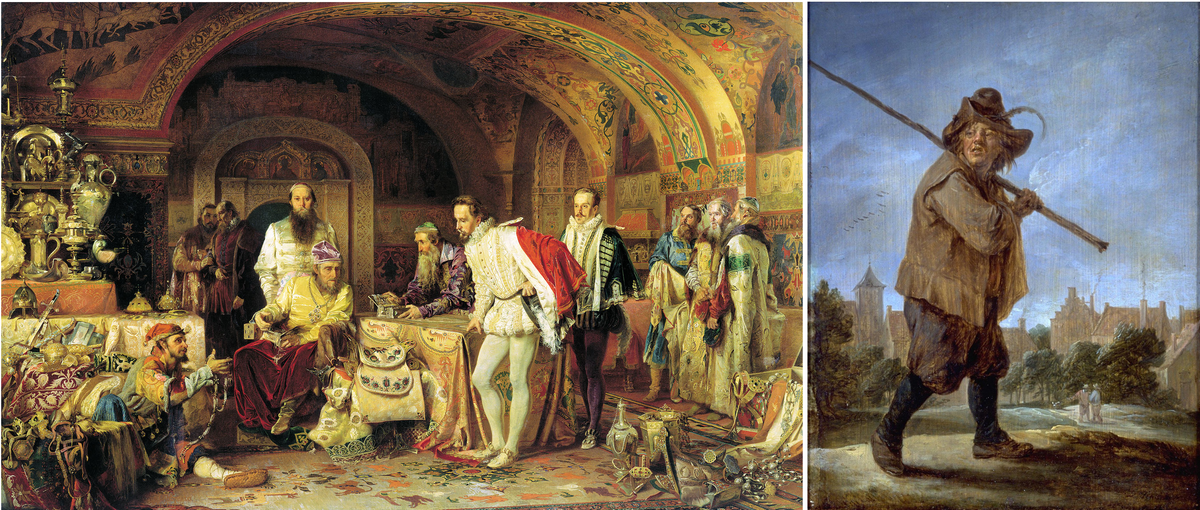
In your work place, your company or organisation do you recognise yourself as being one of the aristocracy or one of the peasants? If you are one of the aristocrats then you probably don’t but if you are a peasant then you will know it.
It isn’t a matter of rank or seniority, though it is connected, it is whether you are in the circle, the gang, one of the guys, ‘U’ rather than ‘non-U’. It is a social group as well as authoritative. Members of the aristocracy make decisions but more importantly they know they are being made and the implications of those decisions even if they didn’t have a hand in making them. Members very often are senior managers but not all senior managers belong and those that do have their own court of sometimes quite junior staff who are part of the aristocracy.
Very often the demarcation between aristocrats and peasants is the kind of work that they do. Service and support divisions and departments are very often all peasants. The heads of those departments may be aristocrats but if they are they were very likely parachuted into their position. A peasant who has risen through the ranks and gained the same kind of title, responsibility and remuneration as one in the aristocracy in such an organisation remains a peasant.
they include those with bright new furnishings, employee perks and foozeball tables
By service and support I don’t just mean facilities such as cleaning or office administration but any of the functions that a particular organisation think are peripheral to the primary purpose. Nor is it about either manual or unskilled work, often it is the very highly skilled worker and the functions are those which enable the primary purpose to be achieved rather than being peripheral. Such organisations succeed because of the commitment of their peasant workforce.
Surely these kinds of organisations are disappearing by being unable to adapt to the modern world, such work places must be archaic and inefficient? They may well be archaic but they include those with bright new furnishings, employee perks and foozeball tables.
But then these kinds of organisations must have existed for some time, must have had this culture from the beginning and just failed to evolve and adapt? This is certainly true for many organisations but it is just as true for startups and any of the more open organisational structures. Matrix structures can have intersecting and overlapping matrices.
Any size or structure of organisation can both begin and acquire an aristocratic cadre. There are some who are more likely, perhaps, to acquire the culture; family firms, partnerships, of all kinds, where partners or a subset of partners are a separate layer, corporations can become aristocracies, either for shareholders or as a defence from shareholders as well as a significant separation from the ‘work force’.
as well as opacity and secrecy the mark of an aristocracy is deference
How then, can we identify whether an organisation has an aristocracy and peasantry? Some of the characteristics include an opaqueness as to decision making, the feeling that decisions percolate down the organisation but are carried by the authority closest to them and not always from an authority in a formal sense. It is not just decision making that is opaque but secrecy is expected internally about any matter, regardless of the context. This naturally includes all conversations about pay and conditions between employees and has the added benefit to the aristocracy of maintaining the status quo.
As well as opacity and secrecy the mark of an aristocracy is deference. The well understood lines which are drawn around individuals which prevent candid and relevant advice being given by a peasant, even if that peasant is in a post with a significantly higher level of responsibility. Are there individuals or classes of colleagues that you cannot challenge? Can you be candid about a policy which is within your competence and in the context of normal work? And if such advice is given is it treated equably?
Then there is the way in which an organisation manages itself and delegates decision making and control. An organisation which uses departmental budgeting for both capital and operational use can delegate control of that budget and its distribution, its use solely under the local management and all that is fine. But if those budgets are purely for the convenience of accounting and cost control and the necessary capital or major project work requires layers of control and negotiation then perhaps there is another fog of decision making which is opaque.
this is not about being anti-capitalist, or pro-socialist or even anarchic
Is the general flow of information and control top down? Are the All Hands meetings primarily to convey decisions that have been made or forced upon the organisation or are they part of a consultative process?
This is not about being anti-capitalist, or pro-socialist or even anarchic. Any organisation, whether its a for profit, a for shareholders corporation, a non-profit charity, a political organisation intent on tearing down the establishment, a Union or a Cooperative; they can all be aristocratic and structured so that the workforce have as much say as peasants in the 14th Century.
What can you do if feel you are a peasant in such an organisation? You could certainly try and find one that wasn’t structured in this way and leave but they are common and hard to spot from the outside. There are Peasant Revolts that happen from time to time, and are one of the signifiers of the imbalance. The revolts tend to be about pay and conditions, the morale, the amount of holidays that some members of staff have, the lack of trust, the isolation of individuals and departments; the malaise of a general unfairness. But this is not just about trade disputes, the Union, if there is one of which staff can be members, can itself be structured in the same kind of way, dressed up in the language of comradeship but still with its own agenda.
Perhaps there is nothing to be done then. For the majority of these organisations I think that is true. A peasant can decide to remain within the peasantry gaining what advantage and security they can or they can search for alternatives.
is this how you treat others?
This is not a piece intended to fix your life. This is more of a challenge, is this how you’re treated? Or is this how you treat others?
Have I ever been part of one of these aristocracies? Sometimes I’ve thought so, but often I’ve realised I’m more of an oily rag, the technocrat of the peasantry. When I have been a member it has never been a comfortable feeling because once you have been accepted within the circle you realise there are other smaller, more select circles. An aristocracy by its nature becomes both paranoid and politic. And then there is all the gossip.